













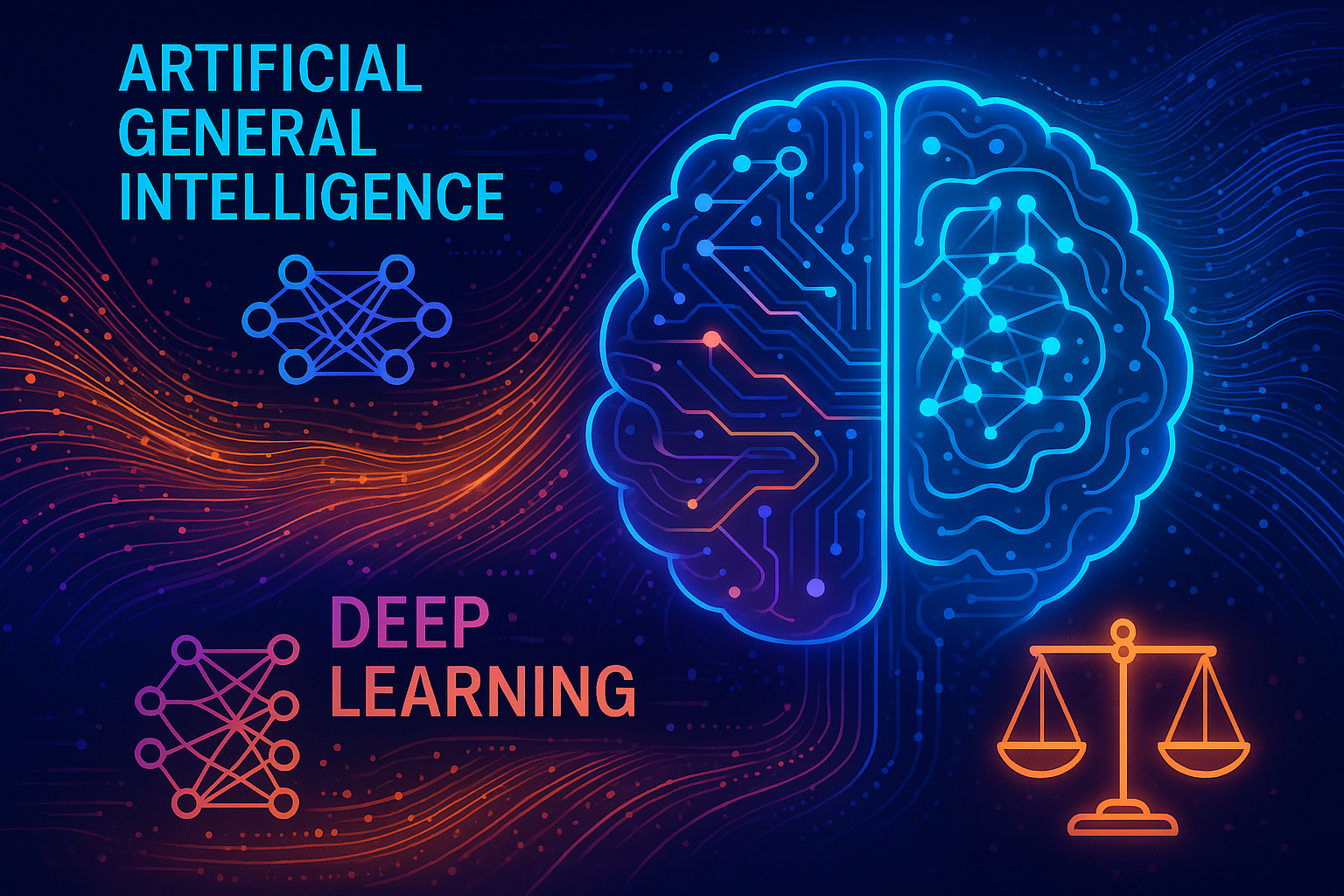
The rise of machine learning and deep learning is reshaping industries at an unprecedented pace, with large language models at the forefront of this revolution impact of large language models and deep learning on artificial general intelligence. As these technologies edge closer to artificial general intelligence, they promise groundbreaking advancements—yet also spark urgent ethical debates. From personalized education to life-saving healthcare applications, AI’s expanding influence is undeniable. But with such rapid progress comes critical questions about responsibility, bias, and the future of human-machine collaboration. How will society navigate this transformative yet contentious landscape? The answers could redefine the way we live, work, and interact with technology.

Deep Learning’s Role in AGI Development
Deep learning has become a cornerstone in the pursuit of artificial general intelligence (AGI), with autoregressive image modeling parallel decoding advancements pushing the boundaries of what’s possible. From the rise of large language models to their inherent limitations, this section explores how deep learning algorithms are shaping—and being shaped by—AGI development.
The Rise of Large Language Models and impact of large language models and deep learning on artificial general intelligence
Large language models (LLMs) are transforming the way humans interact with technology, enabling more natural and intuitive communication. These advanced AI systems, trained on vast datasets, can understand and generate human-like text, making them invaluable for applications like chatbots, content creation, and even coding assistance. By leveraging deep learning techniques, LLMs bridge the gap between human language and machine understanding, opening new possibilities for automation and creativity.
The development of LLMs is rooted in autoregressive modeling, a technique where systems predict sequential data, such as text or images, one piece at a time. This approach, as explored in Tutorial 12: Autoregressive Image Modeling — UvA DL Notebooks, highlights how predictive models can generate coherent outputs by learning patterns from data. The same principles apply to text-based LLMs, which predict the next word in a sequence to produce fluent and contextually relevant responses.
As LLMs continue to evolve, their impact spans industries—from healthcare and education to entertainment and customer service. Companies are integrating these models into their workflows to enhance productivity, while researchers push the boundaries of what AI can achieve. However, challenges like ethical concerns, bias mitigation, and computational costs remain critical areas of focus. The rise of large language models marks a pivotal moment in AI, reshaping how we communicate with machines and unlocking unprecedented opportunities for innovation.
Machine Learning in Modern Applications
Machine learning (ML) is revolutionizing industries by enabling smarter, data-driven decision-making. From healthcare diagnostics to financial forecasting, ML algorithms are being integrated into diverse sectors, showcasing their remarkable versatility. These technologies analyze vast datasets to uncover patterns, predict outcomes, and automate complex processes, making them indispensable in today’s fast-paced world.
In healthcare, ML is transforming diagnostics by improving accuracy and speed. Algorithms can detect anomalies in medical images, predict disease progression, and even suggest personalized treatment plans. This not only enhances patient care but also reduces the burden on medical professionals, allowing them to focus on critical cases.
The financial sector is another area where ML is making a significant impact. Banks and investment firms leverage predictive models for risk assessment, fraud detection, and stock market forecasting. These applications help institutions make informed decisions, minimize losses, and maximize returns, demonstrating ML’s potential to reshape traditional financial practices.
Beyond these fields, ML is also driving innovation in areas like autonomous vehicles, customer service chatbots, and even creative industries such as art and music generation. For instance, recent advancements in autoregressive models, as discussed in Autoregressive Image Generation without Vector Quantization, highlight how ML can produce high-quality images without traditional quantization methods.
As machine learning continues to evolve, its applications will expand further, unlocking new possibilities across industries. The ability to process and learn from data in real-time ensures that ML will remain at the forefront of technological innovation, shaping the future of how we live and work.
Deep Learning and Neural Networks
Deep learning, powered by neural networks, is revolutionizing fields like computer vision and natural language processing (NLP). By mimicking the human brain’s structure, these artificial neural networks can process vast amounts of data, recognize patterns, and make decisions with remarkable accuracy. From facial recognition to real-time language translation, deep learning is enabling breakthroughs that were once considered science fiction.
One of the most exciting applications of deep learning is in autoregressive image modeling, where neural networks generate or predict images pixel by pixel. This technique, as explored in Tutorial 12: Autoregressive Image Modeling (Part 1), demonstrates how neural networks can learn complex visual patterns and create high-quality synthetic images. Such advancements are paving the way for innovations in digital art, medical imaging, and even video game design.
The versatility of neural networks extends beyond images. In NLP, models like GPT and BERT leverage deep learning to understand and generate human-like text. These models are transforming industries by automating customer service, enhancing search engines, and even assisting in creative writing. The ability to process and generate language with nuance is a testament to the power of deep learning architectures.
As research progresses, the potential applications of deep learning continue to expand. From self-driving cars to personalized healthcare, neural networks are at the heart of many cutting-edge technologies. By harnessing the power of deep learning, scientists and engineers are solving some of the world’s most complex problems, making it one of the most transformative technologies of the 21st century.
Ethical Considerations in AI Development
As AI technologies rapidly evolve, ethical concerns surrounding bias, privacy, and accountability have taken center stage. The increasing sophistication of machine learning models, such as those discussed in Autoregressive Image Generation without Vector Quantization, raises critical questions about how these systems should be developed and deployed responsibly. Without proper safeguards, AI risks amplifying societal inequalities and infringing on individual rights.
One of the most pressing ethical challenges is algorithmic bias. AI systems trained on historical data often inherit and perpetuate existing prejudices, leading to discriminatory outcomes in areas like hiring, lending, and law enforcement. Developers must implement rigorous testing protocols to identify and mitigate these biases before deployment, ensuring fair treatment across diverse populations.
Privacy concerns have also intensified as AI systems process vast amounts of personal data. The ability of advanced models to generate realistic content, as demonstrated in recent research, creates new risks for misuse and manipulation. Strong data governance frameworks and transparent data collection practices are essential to maintain public trust in AI applications.
Accountability remains another critical issue in AI ethics. As autonomous systems make increasingly complex decisions, determining responsibility for harmful outcomes becomes challenging. Policymakers and developers must work together to establish clear liability standards and oversight mechanisms that balance innovation with public protection.
The path forward requires multidisciplinary collaboration between technologists, ethicists, and policymakers. By addressing these ethical considerations proactively, the AI community can harness the technology’s potential while minimizing its risks. Ongoing research, like the work presented at NeurIPS, must continue to explore both the technical capabilities and societal implications of artificial intelligence.
AI’s Impact on Education and Healthcare
Artificial Intelligence (AI) is revolutionizing the education sector by enabling personalized learning experiences tailored to individual student needs. Adaptive learning platforms leverage AI algorithms to analyze student performance, identify knowledge gaps, and deliver customized lesson plans. This approach enhances engagement and improves learning outcomes by catering to different learning styles and paces.
In healthcare, AI is making significant strides through predictive analytics and advanced diagnostics. Machine learning models can process vast amounts of medical data to detect early signs of diseases, recommend treatment plans, and even predict patient outcomes. These innovations are helping medical professionals make faster, more accurate decisions while improving patient care.
The integration of AI in these critical sectors is supported by cutting-edge research, such as the A Survey on Vision Autoregressive Model, which explores advanced AI techniques. As these technologies continue to evolve, they promise to further transform how we learn and receive medical care, making education more accessible and healthcare more precise.
The Future of Artificial General Intelligence
Researchers are making significant strides toward achieving artificial general intelligence (AGI), a form of AI capable of understanding, learning, and applying knowledge across diverse tasks like a human. While narrow AI excels in specific domains, AGI remains an elusive goal, requiring breakthroughs in reasoning, adaptability, and contextual understanding. Recent advancements in deep learning and neural networks suggest progress, but experts caution that substantial challenges lie ahead.
One promising approach involves autoregressive models, which predict sequential data by analyzing previous inputs. These techniques, often used in image and language generation, demonstrate how AI can learn complex patterns. For example, Tutorial 12: Autoregressive Image Modeling — UvA DL Notebooks highlights how such models can generate coherent images pixel by pixel, showcasing their potential for broader cognitive tasks.
Despite these innovations, AGI development faces hurdles like computational limitations, ethical concerns, and the need for unsupervised learning. Unlike narrow AI, AGI must generalize knowledge without extensive labeled datasets—a capability still in its infancy. Researchers emphasize interdisciplinary collaboration, combining neuroscience, robotics, and cognitive science to bridge the gap between specialized AI and human-like intelligence.
The road to AGI may be long, but each breakthrough brings the possibility closer. As algorithms grow more sophisticated, the line between human and machine intelligence continues to blur, raising profound questions about the future of technology and society.
As artificial intelligence continues to evolve at an unprecedented pace, large language models and deep learning systems are reshaping industries, from healthcare to education. While these advancements edge us closer to artificial general intelligence, they also spark urgent ethical debates about accountability, bias, and societal impact. The transformative potential of AI is undeniable—but as its influence grows, so do the questions about how to harness its power responsibly. What does this mean for the future of work, creativity, and human-machine collaboration? The answers could redefine the boundaries of innovation.