















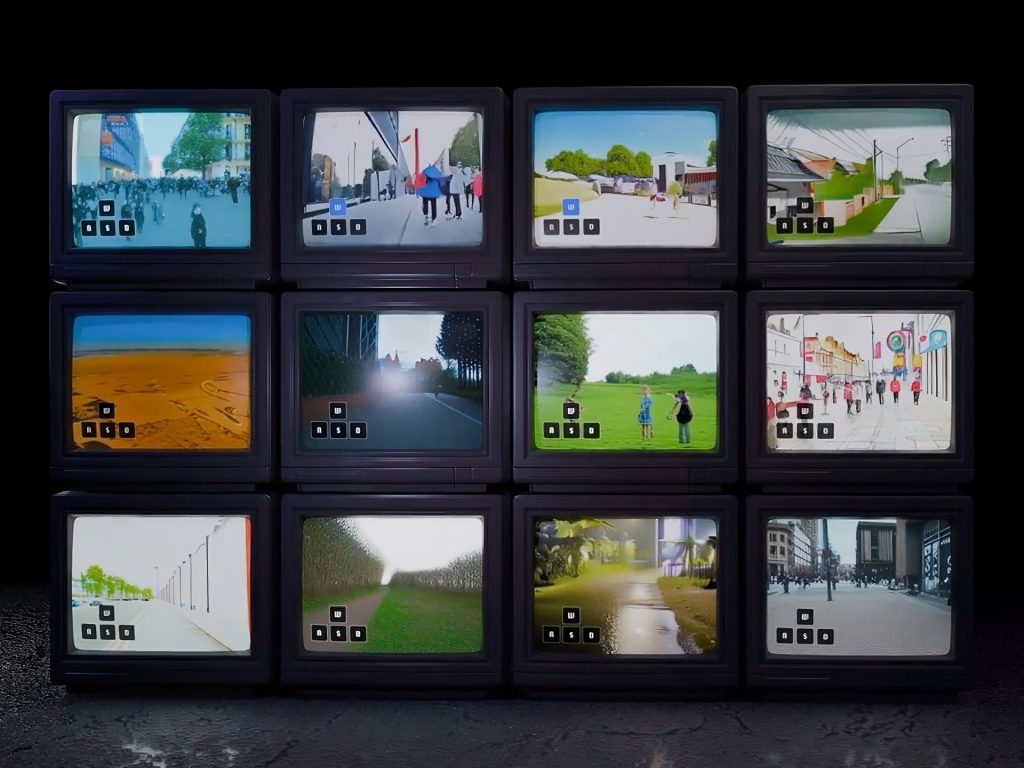
London-based AI research lab Odyssey has introduced a research preview of its AI-generated interactive video technology—a potential gamechanger in the evolution of digital entertainment. The new system allows users to interact with video environments in real time, combining generative AI and immersive simulation into what Odyssey calls an “early Holodeck.” [Source]

Odyssey Unveils AI-Generated Interactive Video Technology, Redefining the Future of Digital Worlds
London-based AI lab Odyssey has launched a research preview of a groundbreaking technology that could reshape the entertainment industry: AI-generated interactive video. Unlike traditional video or gaming formats, this model allows users to influence on-screen action in real time using a keyboard, controller, or even voice commands—transforming passive video into an immersive, dynamic environment. [Source]
The Odyssey team describes their project as an “early version of the Holodeck,” referring to the iconic Star Trek simulation room. Their AI can generate high-quality video frames every 40 milliseconds, creating the illusion of seamless, real-time interaction. While the visuals are still raw and experimental, the concept hints at a new entertainment medium with enormous potential.
Unlike CGI or conventional game engines, Odyssey’s system is built around a “world model”—an action-conditioned dynamics model that reacts to user inputs frame-by-frame. Similar to how large language models predict the next word, this AI predicts the next video frame based on user action, context, and previous frames. The result? An experience that feels unpredictable and organic, not governed by rigid logic trees or scripted events.
One of the toughest challenges in AI-generated video is known as “drift”—when small prediction errors accumulate and degrade the output. Odyssey addresses this with a narrow distribution model, pre-training on general video content and fine-tuning on smaller datasets to enhance frame stability. While this limits environmental diversity, it greatly improves performance and realism.
Cost is another hurdle. Odyssey’s current infrastructure, powered by clusters of H100 GPUs, costs approximately £0.80–£1.60 per user-hour. But compared to the expense of traditional film or game development, these costs are relatively modest and are expected to drop as model efficiency improves.
As Odyssey’s official research page explains, the technology isn’t just about entertainment. Potential applications include interactive training modules, virtual tourism, educational simulations, and adaptive advertising. If this research succeeds, it could spark an entirely new era of storytelling—one that blurs the lines between viewer and participant.
While still in its early stages, Odyssey’s innovation represents a bold step forward for immersive AI experiences. The current preview is more of a technical showcase than a polished product, but it offers an exciting glimpse at what might be the next frontier in digital interaction.
To experience the future of interactive AI firsthand, try the Odyssey research demo today.
Frequently Asked Questions about AI-Generated Interactive Video Technology by Odyssey
What is AI-generated interactive video technology by Odyssey?
It’s an emerging technology developed by London-based lab Odyssey that enables real-time interaction with video content. Unlike traditional video playback, this AI-generated interactive video technology allows users to influence video outcomes dynamically using input devices like keyboards or voice commands.
How does Odyssey’s interactive video system work?
The system uses a “world model”—an AI framework that generates new video frames based on user actions and prior context. This makes the video feel organic and unpredictable, unlike scripted or pre-rendered content found in games or movies.
Is Odyssey’s AI-generated interactive video technology available to the public?
Yes, a research preview of Odyssey’s interactive video platform is currently available. You can try the demo here.
What are the possible applications of this technology?
Beyond entertainment, Odyssey’s AI-generated interactive video technology could revolutionize sectors such as education, virtual training, tourism, and digital marketing. Imagine being able to practice job scenarios or explore virtual destinations in real time.
How is this different from traditional video games?
While video games use fixed logic and pre-designed assets, Odyssey’s AI-generated system creates frames on the fly using predictive models. This results in more natural interaction and greater storytelling flexibility.